FRAG Pro Shooter
- 4.3
- Rating
- 100.00M
- Installs
- Free
- Price
 Analysis by App-foxy
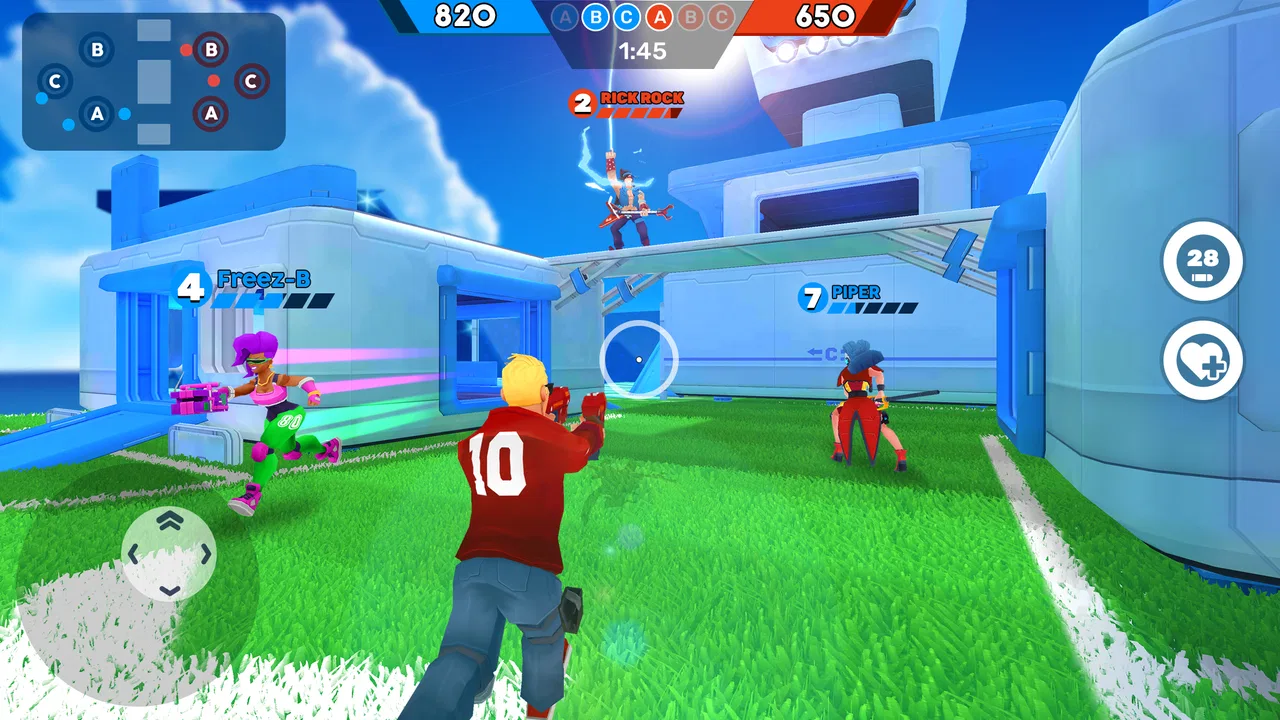
FRAG Pro Shooter is the kind of action game that makes a strong first impression because it gets you into a match quickly. I choose a hero, build a team, step into a compact arena, and immediately have something to react to. That direct loop is the main reason I kept returning during my first sessions. It does not ask me to learn a complicated story before the action starts, and its bright presentation makes every character easy to recognize while I am moving under pressure.
After spending time with it, though, my opinion became more specific. The game is excellent at creating short bursts of excitement, but its long-term value depends on whether I enjoy improving through repeated matches rather than simply chasing novelty. The question is not whether it is fun at the start; it is whether the team-building, hero choices, and arena combat continue to give me meaningful decisions once the basic controls feel familiar.
Developed by Oh BiBi, this free action title has reached a very large audience, with over 100 million installs and an average rating of 4.3 from around 2.2 million ratings. Those figures suggest that the central idea is easy to understand and broadly appealing. It is rated Teen, and the current version is 5.1.0. I tested it with the mindset of someone deciding whether to keep it installed, not merely whether it can fill a spare ten minutes.
You May Also Like

 Blood Strike: 2.5 Anniversary
Blood Strike’s Loadouts Turn Every Drop Into a Tactical Gamble
A close look at Blood Strike’s custom loadouts: how fast access to signature weapons reshapes its battle royale rhythm, rewards preparation, and narrows the gap between fights.

 Pandora - Music & Podcasts
Pandora’s Music Is Easy to Start, but Harder to Recover
Pandora’s strength is its low-effort path from a seed to a station. Its weak spot is how much confidence it asks you to place in connection, setup, and quiet recovery.

 8 Ball Pool
 Is Built on Rivalries, Rematches, and Routine
A close look at the rivalries, rematches, shared routines, and unanswered safety questions that turn a quick pool match into a persistent mobile community.

 Samsung Music
’s Quiet Strength Is Playing What You Already Own
Its reach comes less from spectacle than from dependable access to a personal library. That simplicity is both the app’s strongest retention engine and its ceiling.

 AccuWeather: Weather Radar
AccuWeather Review: A Quick, Clear Forecast for Everyday Decisions
For everyday plans, the best forecast is the one you can understand quickly. AccuWeather makes rain timing, radar, and local conditions easy to act on, with a few trade-offs.

 Hill Climb Racing
Why Hill Climb Racing Still Turns Crashes Into One More Run
A tiny car, a bumpy hill and one more upgrade: Hill Climb Racing keeps resurfacing because its simple chaos makes every near-miss feel personal.
More From Our News Desk



Why the first week feels so inviting
The opening appeal comes from the combination of immediate control and character variety. Instead of committing to one permanent role, I can choose a hero and shape a team around different ways of approaching a fight. That makes the first sessions feel active even before I understand every matchup. A character that seems comfortable in one situation may feel awkward in another, so experimenting is more useful than blindly selecting the most impressive-looking option.
I particularly like how the team concept changes the way I think about a match. I am not only asking whether I can aim or move well. I am also considering which hero should take the lead, which one can cover a weakness, and when changing perspective might be more useful than forcing the same attack. That extra layer gives the game more personality than a simple arena shooter where every round is mostly about reflexes.
The controls are approachable enough for a casual player, but the action still leaves room for mistakes. I can enter a match without preparing for a long session, yet a careless advance can quickly put me in a bad position. This balance is useful on a phone because it gives short play sessions some tension. A round can feel like a complete activity rather than an unfinished fragment of a much larger console-style game.
One practical tip helped me enjoy the opening more: I stopped judging a hero after a single uncomfortable match. A character may feel weak when I use it with the wrong rhythm, especially if I expect every selection to behave like a straightforward damage dealer. Giving each option a few attempts reveals whether the problem is the hero, my positioning, or the way I have assembled the team. That is a better use of early playtime than constantly switching without learning anything.
The visual style also supports quick decisions. Characters and attacks have a lively, exaggerated look, so the battlefield does not feel visually dull. The trade-off is that busy combat can become harder to read when several effects overlap. I sometimes find myself reacting to movement rather than clearly understanding every event on screen. Players who prefer a restrained, highly readable competitive presentation may find the style less comfortable than a more minimalist shooter.
For an everyday scenario, I can see this working well during a commute, a break between tasks, or a short evening session when I want interaction without starting a large role-playing game. I can play a few matches, try a different team arrangement, and stop without feeling that I have abandoned a complicated quest. That convenience is one of its strongest advantages over bigger action games that demand a longer uninterrupted commitment.
Learning the team instead of chasing the newest hero
The most useful early habit is to learn how my selected heroes complement one another. I get more from a modest lineup I understand than from collecting options I never practice. When a team fails, I try to identify the specific problem: am I losing because I cannot hold space, because I approach too aggressively, or because I have no answer for a particular opponent? This turns each defeat into a small lesson rather than a reason to spend immediately.
That distinction matters because the game includes in-app purchases ranging from $0.99 to $199.99 per item. The free entry point is attractive, but the presence of expensive optional purchases means I would recommend setting a personal spending limit before enthusiasm takes over. I do not need to buy anything to decide whether the combat suits me, and I would treat purchases as a convenience rather than proof that I am playing correctly.
Another useful approach is to separate experimentation from competition. I use lower-pressure matches to understand a hero’s movement and timing, then reserve serious attempts for a team I can operate consistently. Constantly testing an unfamiliar lineup when I am already frustrated makes the game feel more random than it really is. A small, deliberate practice routine gives the roster more depth without requiring me to master everything at once.
What keeps it useful after the novelty fades
After the first month, the game’s value comes less from discovering that it is fast and more from deciding what kind of player I want to be. If I enjoy refining choices, remembering how different heroes behave, and adjusting my approach after a loss, there is enough structure to support a regular habit. If I only want a stream of new surprises, the experience can feel thinner once the initial roster and arena excitement become familiar.
The strongest recurring loop is improvement through comparison. I can ask why one team arrangement performs better than another, whether I am wasting a hero’s strengths, and whether a different pace would give me more control. These questions are simple, but they make repeated matches more purposeful. The game rewards attention to habits: rushing, staying exposed too long, changing targets at the wrong moment, or relying on one favorite character in every situation.
I also appreciate that the team format gives me a reason to revisit heroes I initially dismissed. A selection that feels underwhelming when used alone may become more useful when it fills a particular gap in the lineup. That creates a practical form of replay value. I am not collecting alternatives only for decoration; I am testing whether a different combination solves a problem I keep encountering.
Still, the long-term loop is not equally satisfying for everyone. Players who prefer a clearly defined campaign, a deep narrative, or a single character with a carefully developed progression path may find the repeated arena structure less rewarding. Compared with a traditional single-player action game, FRAG Pro Shooter offers less of the feeling that I am traveling through a world. Compared with a slower tactical shooter, it gives me less time to plan and more pressure to react.
That comparison helps define its audience. I would choose it over a large story-driven game when I want quick competitive action and over a basic casual shooter when I want team decisions to affect how I play. I would choose a campaign-focused alternative when I want exploration, a narrative payoff, or a calmer sense of advancement. I would also choose a more methodical shooter if my main pleasure comes from precise coordination rather than rapid switching between immediate threats.
How to build a sustainable play routine
My best month-to-month routine is to play with a narrow goal rather than treating every match as a test of my entire ability. One session might focus on staying alive longer; another might focus on learning when to change heroes; another might be about identifying which teammate or opponent is creating the most pressure. Specific goals make progress easier to notice and reduce the temptation to blame every loss on luck or balance.
I would also avoid spending simply because a match went badly. Frustration makes a purchase feel like a solution, but it does not replace learning the arena or understanding the team. I first return to a familiar lineup, make one adjustment, and see whether the result changes. This approach protects the free-to-play appeal and makes any later purchase a considered choice rather than an emotional reaction.
For someone playing on a regular schedule, variety should come from changing decisions, not from forcing constant novelty. I get more lasting value by revisiting a hero with a new team purpose than by abandoning it after one defeat. That is a non-obvious strength of the design: the roster can act as a set of tactical tools, but only if I spend enough time noticing what each tool actually contributes.
Where the maintenance burden appears
The game is easy to start, but maintaining interest requires more attention than the store summary suggests. I need to remember which heroes I have practiced, which combinations feel reliable, and which mistakes keep repeating. That is not a technical maintenance burden so much as a mental one. The game asks me to keep learning, and players who want a completely effortless pastime may eventually find that work tiring.
There is also the ordinary pressure created by a free game with optional purchases. The price of entry is zero, which makes trying it simple, but the broad purchase range can influence how I think about progression and competition. I prefer to decide in advance whether I am a no-spend player, an occasional spender, or someone willing to pay for convenience. Having that boundary makes the experience feel more controlled.
Version 5.1.0 gives the game a current point of reference, but a live action game is judged over time by how well it remains comfortable to return to. I pay attention to whether familiar matches still feel purposeful, whether my team choices continue to matter, and whether the experience encourages learning instead of merely repeating the same routine. Those are more important to me than a single exciting session.
The minimum operating requirement is Android 7.0, which makes the game accessible to many older Android devices. Even so, practical comfort can vary from one phone to another. A fast action game is less enjoyable when controls feel cramped or the display becomes hard to read during busy moments. Before committing to long sessions, I would test a few matches on the device I plan to use and check whether movement and visual feedback feel dependable.
Because it is rated Teen, I would not treat it as a game for very young children. That rating is also a useful reminder that the action-focused presentation is aimed at players who are comfortable with competitive combat. For families, I would make the age decision based on the individual player and keep purchases under deliberate control rather than assuming that a free download has no financial risk.
What causes fatigue over time
The first source of fatigue is repetition without a personal objective. If I enter matches only to win and do not understand what I am trying to improve, a losing streak makes the whole game feel flat. The compact format is convenient, but convenience can expose repetition quickly. A short session is refreshing when I have a reason to play; it becomes mechanical when I am simply pressing the next-match button.
The second source is visual and tactical overload. The colorful presentation gives the game energy, yet crowded encounters can make it difficult to identify the most important threat immediately. I sometimes need to slow my decisions mentally even when the match itself does not slow down. Players who are sensitive to busy effects or who want a very clean competitive interface should try it before investing much time.
The third is roster fatigue. Having several heroes to consider is initially liberating, but it can also create indecision. I may spend too much time changing my team instead of learning one properly. My solution is to keep a dependable core and alter only one slot at a time. That preserves experimentation while giving me a stable reference point for judging whether a change actually helps.
Purchasing pressure can add another kind of tiredness. Even when I am not spending, the existence of items at different prices can make the game feel less like a simple pick-up-and-play toy and more like a hobby that needs boundaries. I would skip it if I know I dislike free-to-play systems on principle. A paid game with a fixed structure may be a better fit for someone who wants all progression decisions to be separate from a store.
Finally, the game is not ideal for players who need a strong offline-style experience or a long-form story to justify returning. Its appeal is tied to active matches, team choices, and the satisfaction of getting better at a repeatable format. That is a clear identity, not a flaw, but it means the game should be judged against competitive action titles rather than against narrative adventures.
My long-term verdict
FRAG Pro Shooter earns lasting space on my device when I treat it as a compact action practice rather than an endless source of novelty. Its best qualities are immediate matches, a team-based hero structure, and enough tactical variation to make familiar battles worth reconsidering. I can recommend it to players who enjoy testing lineups, learning from mistakes, and fitting competitive action into short parts of the day.
I would be more cautious with someone who wants a campaign, a quiet single-player atmosphere, or a purchase-free progression experience. The free download makes it easy to try, but optional items from $0.99 to $199.99 mean sensible spending boundaries are important. The Teen rating also makes it better suited to older players who are comfortable with action combat and the habits of a competitive mobile game.
My final recommendation is to give it a focused trial rather than judging it by the first burst of excitement. Learn a few heroes, keep one dependable team, and play several sessions with a clear improvement goal. If that process remains satisfying, the game has genuine recurring value. If the matches already feel repetitive once the novelty disappears, no amount of roster switching will turn it into the story-driven or methodical experience you may actually be looking for.
In my experience, this is a strong choice for quick, colorful arena action and a less convincing choice as an all-purpose game. Oh BiBi has built a format that is easy to enter but rewards players who are willing to pay attention. That combination gives it a real chance of becoming a regular habit, provided I enjoy the discipline of refining a team as much as the excitement of entering the arena.
FAQs for FRAG Pro Shooter
01What is the gameplay style of FRAG Pro Shooter?
FRAG Pro Shooter offers a unique blend of first-person and third-person shooting mechanics, providing fast-paced, action-packed gameplay. Players take control of a team of characters, each with distinct abilities, and switch between them in real-time. The objective is to outscore opponents by strategically using skills and teamwork, making it accessible for both casual and competitive players.
02Is FRAG Pro Shooter free to play, and are there in-game purchases?
Yes, FRAG Pro Shooter is free to download and play on both Android and iOS devices. However, it does include in-game purchases. Players can buy in-game currency to unlock new characters, skins, and other items. While purchases can enhance the experience, they are not necessary to enjoy or progress in the game.
03What kind of characters can players choose from in FRAG Pro Shooter?
FRAG Pro Shooter features a diverse roster of characters, known as ‘Fraggers,’ each with unique abilities and playstyles. Players can choose from over 90 characters, including offensive, defensive, and support types, allowing for strategic team composition. Regular updates add new characters, keeping gameplay fresh and engaging.
04Does FRAG Pro Shooter require an internet connection to play?
Yes, FRAG Pro Shooter requires an internet connection for gameplay. The game is primarily focused on online multiplayer battles, where players compete against others in real-time. While there are options to practice offline, the main experience revolves around competing with or against other players online.
05Can FRAG Pro Shooter be played with friends, and is there a team mode?
Absolutely! FRAG Pro Shooter allows players to team up with friends and participate in cooperative matches. There are various team modes where players can join forces to strategize and outplay opponents. This social aspect enhances the fun and competitiveness, making it a great choice for playing with friends.
Pros
- Engaging and fast-paced gameplay.
- Variety of characters to choose from.
- Frequent updates with new content.
- User-friendly interface and controls.
- Multiplayer mode enhances experience.
Cons
- In-app purchases can be costly.
- Occasional connectivity issues.
- Some characters feel unbalanced.
- Battery drains quickly during play.
- Ads can be intrusive at times.

FRAG Pro Shooter
Gallery